


Cornelius David Krieghoff was born in Amsterdam, raised in Germany, and studied painting in Bavaria. He was also likely influenced by genre painting produced in academies in Dusseldorf under the teaching of Wilhelm von Schadow, where he lived in the 1830s. Krieghoff travelled to the US in 1837 and volunteered in the American army, joining the war against the Seminole Indians in Florida.
In 1840, while living in New York, he met and married Émilie Gauthier, a French Canadian, and they later moved to Boucherville, a suburb of Montreal, Quebec, and Toronto where his career began and he first advertised himself as a painter. Krieghoff initially focussed on painting portraits, which were followed later by the social scenes and landscapes he became known for. His work fuses these themes and resembles that of military topographers such as James Pattison Cockburn, the earlier Montreal painter, Martin Somerville, and the tradition of 17th-century Dutch genre painting, known for its depictions of an array of social figures.
In 1845, Krieghoff moved to Paris where he registered at the Louvre as a copyist under the tutelage of Michel-Martin Drölling, further developing his skill for genre compositions and landscape.
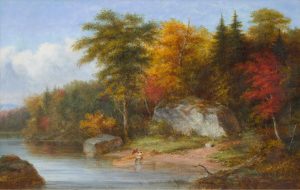
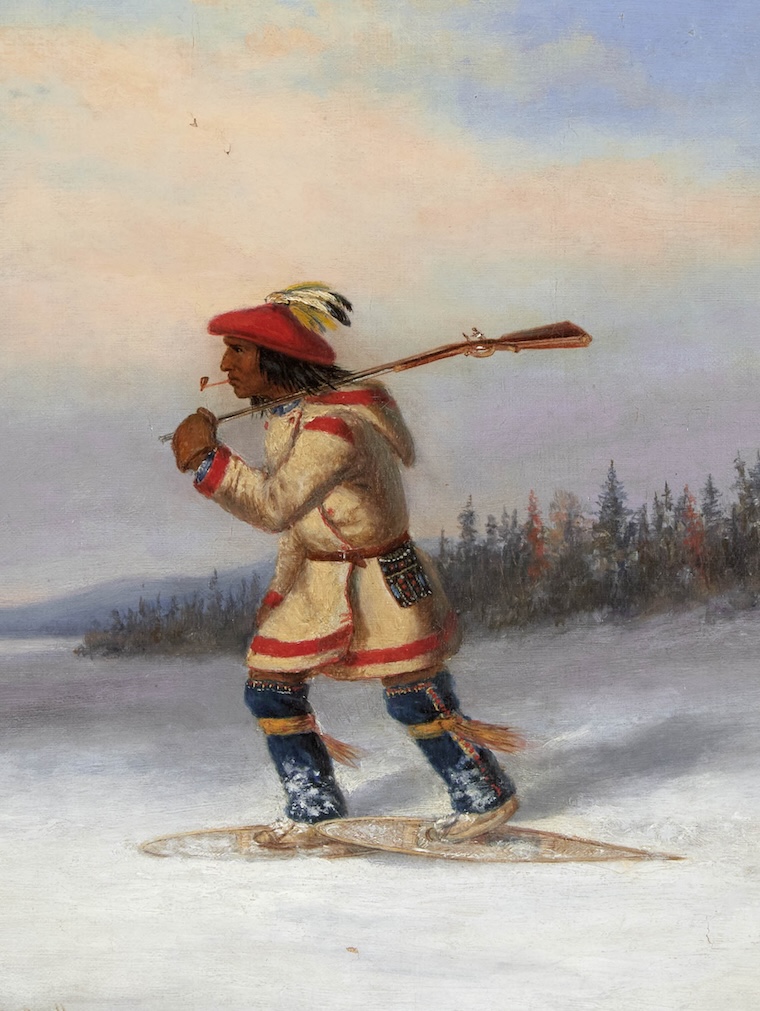
INDIANS AT A PORTAGE, 1865
oil on canvas, 14 x 21.75 in — 35.6 x 55.9 cm
Krieghoff returned to Montreal, Canada in 1846. He produced prints of his own paintings which appealed to an aspiring middle class and moved to Quebec City in 1853 where he connected with auctioneer, John Budden, who was employed by A.J. Maxham & Company. Budden introduced Krieghoff to the city’s elite, including local merchants and British military officers. In 1852, the city had also once again become the capital of the Province of Canada and Krieghoff benefitted from the resulting increase in trade.
The array of scenes he depicted included the full range of life in early French Canada, from quotidian labour such as trading, trapping, farming, hunting and ice-fishing, to images of Indigenous settlements, card-players and celebrations at the local public house, to sugar harvesting, and horses and carriages.
A savvy businessman with an entrepreneurial approach, Krieghoff’s market was primarily Anglophone. At the same time as he produced numerous small paintings depicting various views of the same scene or individual, he also began making engravings and lithographs. These recurring themes for his work focussed on popularizing fall and winter scenes from Quebec, folksy settings and a variety of characters which he widely reproduced, from Indigenous peoples to the early habitant settlers, who were farmers in the ‘New France.’ His were the first formal landscapes from the region and departed from those of topographers who worked primarily in watercolours electing for a traditional approach to easel painting, using finished oils on canvas. Krieghoff’s stays in Quebec were his most prolific periods, and his idealized depictions of rural life were well circulated informing a kind of ‘popular culture’ of its day.
Krieghoff’s figures were often not individual portraits; their focus instead was on the clues provided by clothing and surrounding objects, symbolic interpretation and inventions based on assumptions, repeating motifs and romanticization. As such, they have been critiqued for their role in reinforcing stereotypes and settler colonial narratives of early frontier life. His work was both celebrated by ethnologist Marius Barbeau, who wrote Cornelius Krieghoff: Pioneer Painter of North America in 1934 and criticized by art historian Gérard Morisset for their generic representations, including of First Nations people. He moved to Europe in 1863, and continued to work, maintaining his network of connections in Quebec, painting and selling the same Canadian themes from a distance and in 1870, he moved to Chicago where he died in 1872. Over his career, Krieghoff produced an estimated 1500-2000 works including paintings and prints, and his popular work was the source of imitation and forgery.
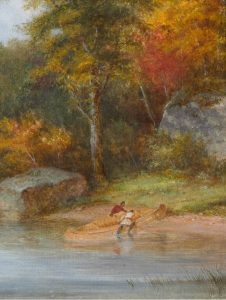 In Indians at a Portage, Krieghoff offers what would have been a highly popular view of the Quebec wilderness: a peaceful scene of two Indigenous men portaging their birchbark canoe onto a river shore. A folksy version of the sublime is alluded to, through Krieghoff’s use of formal 19th century pictorial traditions embedded in an untroubled view of nature, where land is presented as an object of contemplation through the removal of any political or local tensions. The portage was an efficient method of travel and trade initiated by Indigenous people throughout what later became known as Quebec; their ancient routes were used by the French-Canadian voyageurs, who learned from them, the most reliable and efficient ways to navigate trade routes.
This image, created at the same time that railways such as the Canadian Pacific, Grand Trunk and other settler routes would have been overtaking longstanding traditional trade routes used for centuries by Indigenous people, also alludes to a romantic settler view of a past and disappearing way of life.
Contributed by Lisa Baldissera. Baldissera has worked in curatorial roles in public art galleries in Western Canada since 1999, including Senior Curator (Contemporary Calgary), Chief Curator (Mendel Art Gallery) and Curator of Contemporary Art at the Art Gallery of Greater Victoria. She has produced more than seventy exhibitions of local, Canadian, and international artists and holds MFAs in Creative Writing (UBC), Art (University of Saskatchewan) and a PhD in Art Writing and Curating (Goldsmiths College). She is the author of Emily Carr: Art and Life (Art Canada Institute) and Convoluted Beauty: In the Company of Emily Carr (Mendel Art Gallery). She is currently the Director of Griffin Art Projects in North Vancouver, BC.
ABOUT THE AUCTION
Headlining our major fall 2026 Canadian & International Fine Art auction are works by renowned Canadian artists Cornelius Krieghoff, Gordon Appelbe Smith, Frederick Arthur Verner, A.J. Casson, A.Y. Jackson, and William Kurelek, alongside international offerings by Edouard Cortès and Henri Lebasque. Also featured is a collection of works by Georges Mathieu, David Milne, and Eduardo Paolozzi from an Important Private Collection. Additional highlights include exceptional, unpublished works by Fernand Léger and Sir Alfred James Munnings.
On View:
Saturday, November 14 from 12 pm to 4 pm
Sunday, November 15 from 12 pm to 4 pm
Monday, November 16 from 10 am to 5 pm
Tuesday, November 17 from 10 am to 7 pm
Wednesday, November 18 from 10 am to 5 pm
Or by appointment.
Please contact us for more information.
Related News
November 5, 2026
November 5, 2026
November 5, 2026
June 8, 2026

May 6, 2026
May 4, 2026
May 4, 2026
May 1, 2026
Meet the Specialists

Goulven Le Morvan
Director, Fine Art

Alicia Bojkov
Specialist, Fine Art

Claire Laycock
Associate Specialist, Fine Art
Canadian Fine Art, International Art, Appraisals & Consignments