


A great collection is rarely the work of a single individual. It is through the many intersections with collectors, dealers, scholars and auction houses that items accumulate histories beyond their origins, telling stories of connoisseurship, discovery, and geography. Join us in a look at the second of four featured lots with exceptional provenance in our major fall 2026 auction of Inuit Art.
In looking at one of Tudlik’s iconic owls, it is remarkable to consider that they were carved by an artist born in 1890. Strikingly modern, their truncated bodies are charged with sign-like directionality and clarity of form.
After a lifetime spent surviving off of the land, where keen eyesight is essential to one’s survival, Tudlik’s eyesight was significantly diminishing in the 1950s. Scholars sometimes hint at this impediment as a source of the simplicity in his work.[1] Whatever the reason, Tudlik’s tactile and essential carvings have long been sought after, as have the works of his son Latcholassie Akesuk.
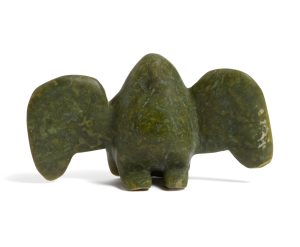
OWL, CA. 1960
stone, 3.75 x 6.75 x 1.75 in — 9.5 x 17.1 x 4.4 cm
The present sculpture, Owl, numbers among the most widely published sculptures by any Inuit artist, included in seminal publications by both George Swinton and James Houston, including the catalogue for the legendary 1971-1973 touring exhibition Sculpture of the Inuit: Masterworks of the Canadian Arctic.
Owl belonged to the pioneering figure in Inuit art, Terry Ryan. For almost 50 years Terry Ryan was the art advisor and general manager of the West Baffin Co-operative (WBEC) in Kinngait (Cape Dorset). Much like his predecessor and fellow Ontario College of Art graduate James Houston, Ryan had a passion for the Arctic, and a love for its people and their art. Speaking of Ryan in his 2017 obituary in The Globe and Mail, John Westren of Dorset Fine Arts said that he had dedicated himself to the task of supporting the co-op: “it was his whole life. He was one of those old-fashioned men of integrity.”[2]
Ryan arrived in the Arctic in 1958 during a period of dramatic change and transition. Traditional Inuit lifeways were being affected by a sudden and dramatic exposure to ideas and technology from the South. It was also a moment of artistic florescence which saw the birth of the print program in Kinngait, and the widespread making of sculpture in stone.
Ryan was one of the few individuals who experienced both firsthand, working intimately with the community in Kinngait, and with the now legendary Inuit artists who defined a unique genre of artmaking. During his long career he built a small but important collection of artworks, most of which came from his many close relationships with artists. The present artwork is one of five in the current auction acquired from the Terry Ryan Collection.
[1] George Swinton, Sculpture of the Eskimo (Toronto: McClelland and Stewart, 1987), 8.
[2] Stoffman, Judy. “The godfather of Inuit art.” The Globe and Mail. 17 Sep 2017. https://www.theglobeandmail.com/arts/art-and-architecture/inuit-arts-patron-terry-ryan-had-a-passion-for-thearctic/article36286400/
Provenance
The Collection of Terry Ryan, Toronto, ON
The Ryan Collection, Feheley Fine Arts, Toronto, ON, 1998
An Important Two-Generation Private Collection
Exhibited
Sculpture of the Inuit: Masterworks of the Canadian Arctic, Canadian Eskimo Arts Council Vancouver Art Gallery, Vancouver, BC
Le Grand Palais, Paris, FR
Nationalmuseet, Copenhagen, DK
British Museum, London, UK
Pushkin Fine Arts Museum, Moscow, RU
The Hermitage, St. Petersburg (Leningrad), RU
Philadelphia Museum of Art, Philadelphia, PA
National Museum of Man (Canadian Museum of History), Gatineau, QC
National Museums of Canada (National Gallery of Canada), Ottawa, ON, 1971-1973.
The Ryan Collection: Early Cape Dorset Sculpture, Feheley Fine Arts, Toronto, ON, 9 May-6 Jun 1998.
Literature
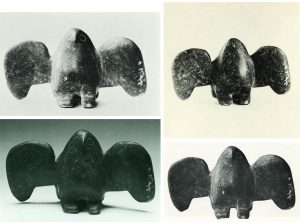 Top left: George Swinton, Eskimo Sculpture/Sculpture Esquimaude (Toronto: McClelland & Stewart, 1965), 170.
Top right: George Swinton, Eskimo Sculpture/Sculpture Esquimaude (Toronto: McClelland & Stewart, 1965), 170.
Bottom right: George Swinton, Sculpture of the Eskimo (Toronto: McClelland and Stewart, 1972/1992), 188, pl. 471.
About the Auction
Highlights of our 2026 major fall auction of Inuit Art include major works by Abraham Etungat, Osuitok Ipeelee, Henry Evaluardjuk, Pudlo Pudlat, Tudlik, Niviaxie, Kenojuak Ashevak, Barnabus Arnasungaaq, Lukta Qiatsuk, Ningiukulu Teevee, Pitaloosie Saila, Kananginak Pootoogook, and John Kavik. Also included is a small collection of ancient Arctic ivories.
On view at our Toronto gallery:
Saturday, November 14 from 12 pm to 4 pm
Sunday, November 15 from 12 pm to 4 pm
Monday, November 16 from 10 am to 5 pm
Tuesday, November 17 from 10 am to 7 pm
Wednesday, November 18 from 10 am to 5 pm
Or by appointment.
Contact us for more information at [email protected]
Related News
November 11, 2026
November 11, 2026
November 11, 2026
November 5, 2026
October 28, 2026

August 23, 2026

June 10, 2026
May 13, 2026
Meet the Specialists

Palmer Jarvis
Senior Specialist

Elizabeth Gagnon
Consignment Specialist