


Lot 181
Ted Harrison, RCA (1926-2015)
Additional Images

Provenance:
Private Collection, Edmonton, AB
Note:
Harrison’s distinct painting style is heavily influenced by his upbringing and vast world experience. Having grown up in a mining town in Durham, England before serving his country in World War II, grim coal mines and war bombings were the visual landscape of his youth, a landscape that runs contrary to the bright and cheerful subjects found in his paintings. However, it is these dark experiences that formed Harrison’s artistic philosophy: “death and destruction are sometimes necessary, and evil exists as surely as does good. But we must, at all costs, choose what is good, what is beautiful.”[1]
Harrison moved to Canada in 1968 after living in England, India, East Africa, and New Zealand. He was immediately captivated by the clear air and bright skies of the Yukon - a landscape that became his muse for the next two decades. He gained inspiration from the Woodland School of Art, and his personal art collection grew to include works by Alex Janvier, Norval Morrisseau, Daphne Odjig, Bill Reid, and Arthur Shilling, among others.
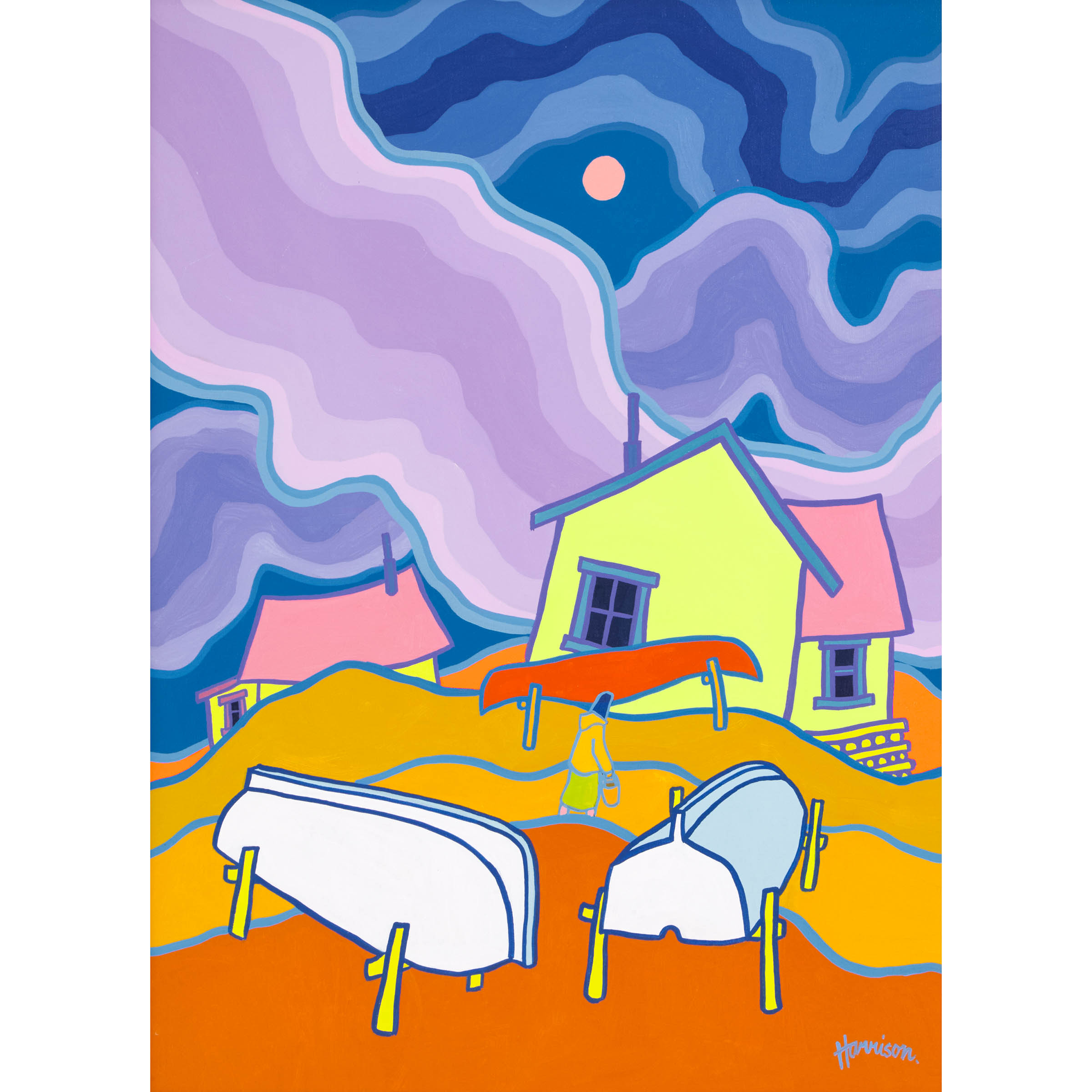
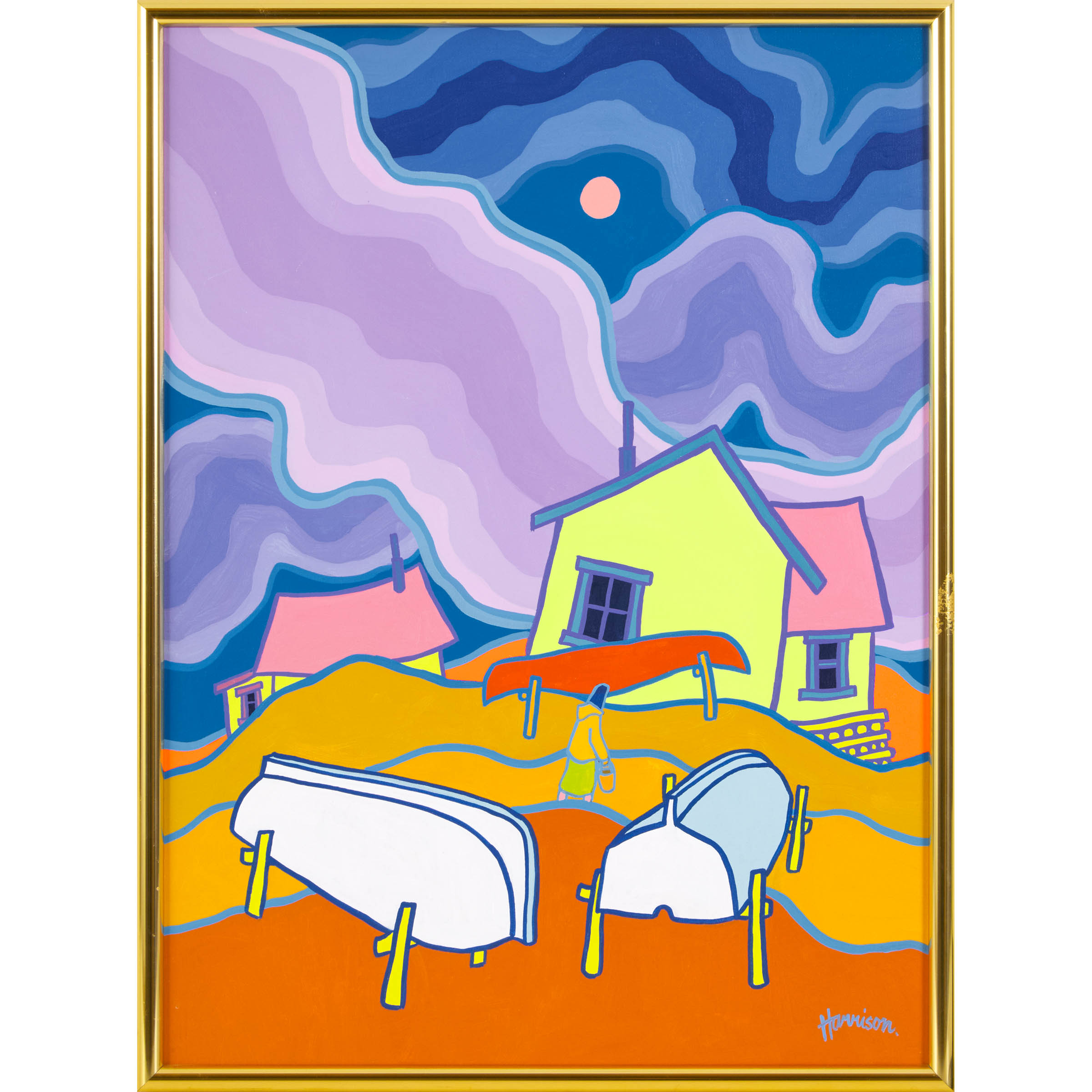
This work is a prime example of Harrison’s prolific mid-period, and wonderfully articulates his many influences. It exhibits a complex harmony between form and colour and the connection between land and sky. The rolling sky and vibrant sun is a recurring theme in Harrison’s work, and can be largely attributed to his love for classical music. Harrison saw art and music as interchangeable and integrated the rhythm and crescendos of the songs he listened to into the waves and spirals of his painted skies. The brilliance of Harrison’s work lies in his ability to channel his many influences, ideas, and inspirations into a simple projection of the Yukon - its vast, open spaces, vivid sunsets, and the rich culture of these communities.
[1] Katherine Gibson, Ted Harrison: Painting Paradise (Victoria: Crown Publications, 2009), 37.