


Lot 15
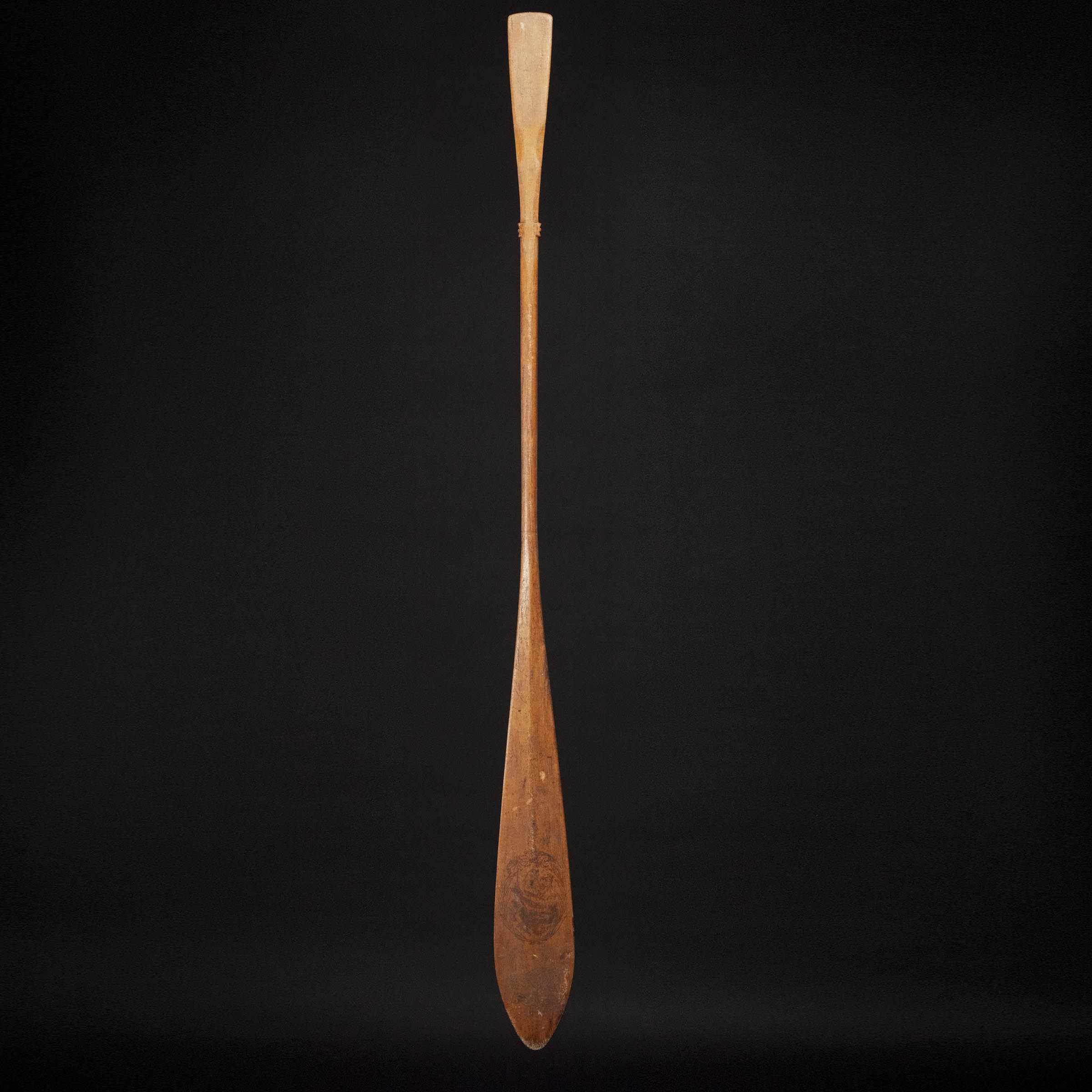
Unidentified Wolastoqiyik (Maliseet) Artist
Additional Images
Provenance:
William T. Chestnut and Ida Caroline Chestnut, Jemseg, NB, ca. 1898/1899
Acquired with the acquisition of the Chestnut family cottage by Chet and Helen Campbell, Jemseg, NB, ca. 1950s
By descent to the present Private Collection, Ontario
Note:
Travel by water was central to the historic culture of the Wolastoqiyik, as it was for their allies the Mi’kmaw to the east, and their neighbours the Peskotomuhkati (Passamaquoddy) and Panawahpskewi (Penobscot) to the west. Essential for hunting and fishing, trade and war, the Wolastoqiyik name itself is said to derive from a phrase which translates to “people of the beautiful river”, in reference to the Saint John River in New Brunswick, around which many Wolastoqiyik have long resided.
The coming of Europeans in the early 18th century, and the establishing of complex networks of trade between the Wolastoqiyik and Europeans led to an initial interdependence between the Wolastoqiyik and the newcomers, which progressively diminished with the decline of the fur trade, and increasing establishment of European settlements into the 19th century.
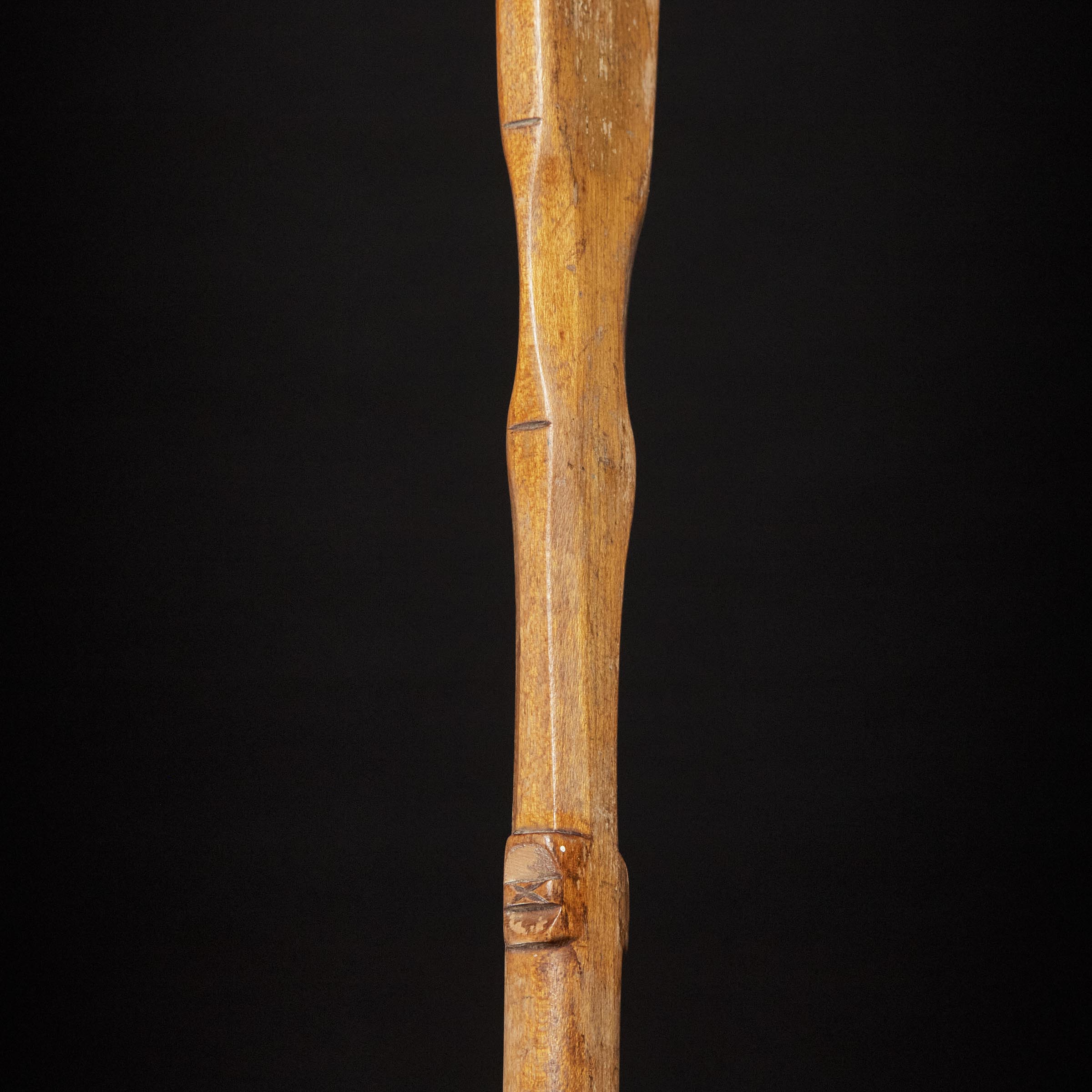
When the fashion for furs in Europe dwindled, trade with Europeans gradually shifted to an emphasis on handicraft. Among goods traded by the Wolastoqiyik were all manner of objects relating to canoes, including exquisitely carved and proportioned paddles. Most Wolastoqiyik paddles were utilitarian tools, lacking extensive ornamentation, Many however were beautifully refined in form, suited to the diverse demands placed on a tool whose users required of them both resilience and lightness, comfort and efficiency.
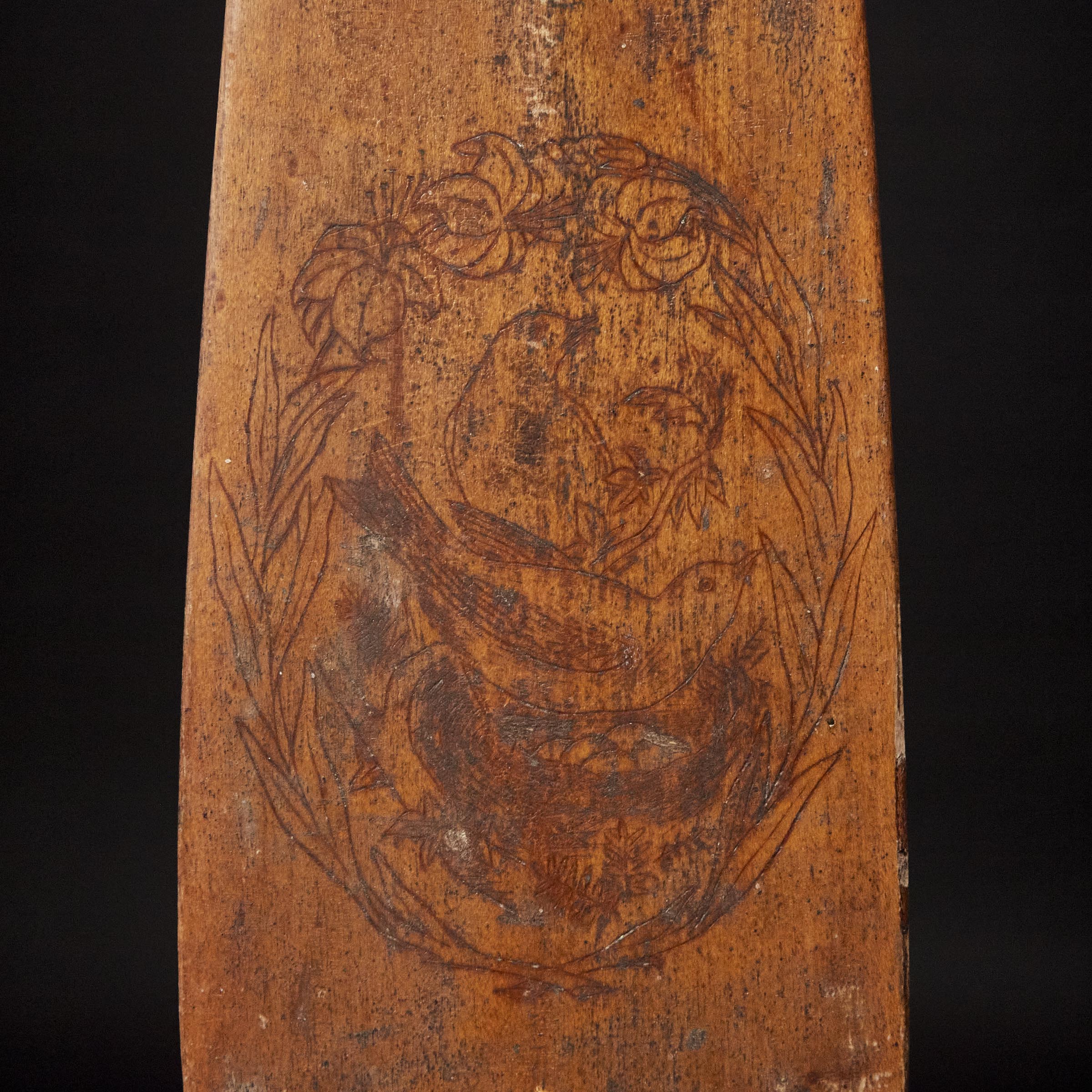
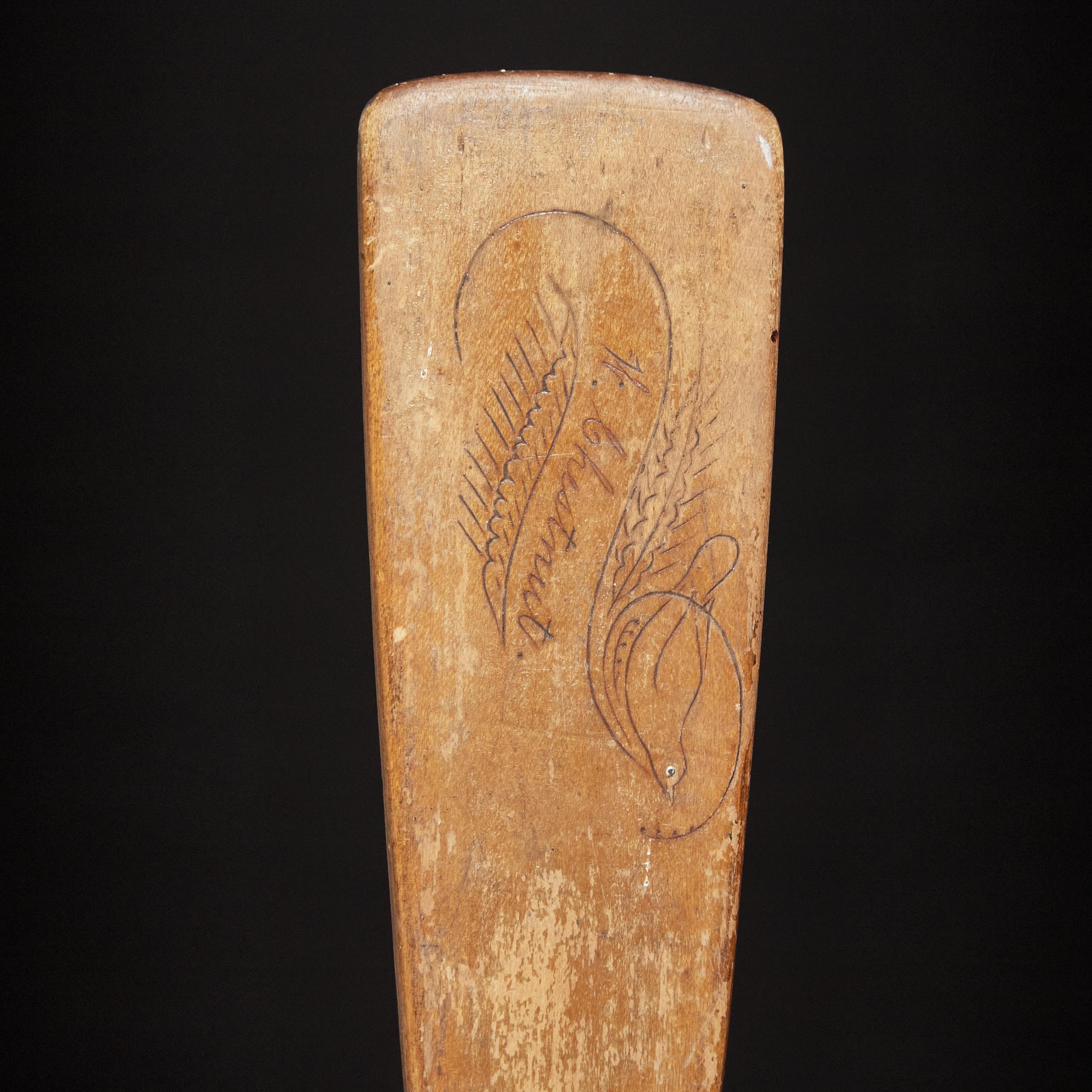
A small number of Wolastoqiyik paddles were highly decorated and made with the utmost delicacy. Surviving examples of this class of paddle are exceedingly rare. Of known examples, four are held in the New Brunswick Museum in Saint John, one in the York Sunbury Museum (now called the Fredericton Region Museum) in Fredericton, New Brunswick, and two in the British museum. All of the known examples are thought to date to the 19th century and were commissioned by European or Euro-American buyers. Of the seven paddles, four depict scenes with illustrations exhibiting a moderate degree of pictorial illusionism, while the remaining three exhibit more abstractly rendered scroll designs. The latter are part of an older body of so-called “double-curve” iconography found throughout the Northeastern Woodlands on objects whose uses spans both the sacred and the profane.
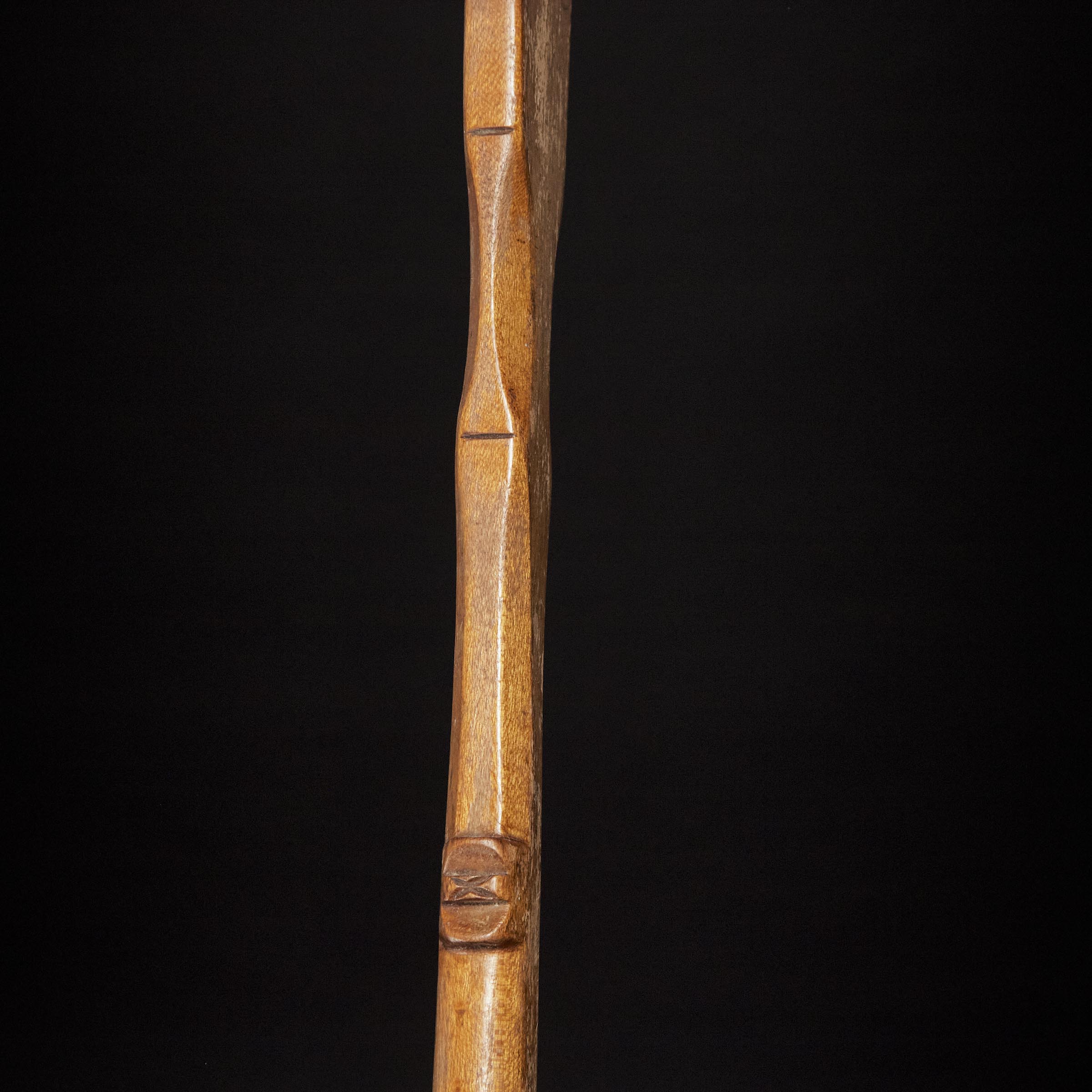
The present paddle is one of three important paddles in this auction, commissioned or gifted by a Wolastoqiyik maker, or makers, in Jemseg, New Brunswick, to William T. Chestnut, and his wife Ida Caroline Chestnut circa 1898/1899. It was William T. Chestnut and his brother Henry Chestnut who founded the iconic Chestnut Canoe company in Fredericton, New Brunswick in 1907, one of North America’s pioneering commercial canoe manufacturers.
The paddles were acquired by Chet and Helen Campbell circa 1950s upon their purchase of the Chestnut family cottage on Grand Lake in Jemseg, New Brunswick. The paddles have since passed by descent to the present private collection, and have been previously unknown to collectors and scholars, having remained in the Chestnut cottage for more than 100 years.
For the two other Wolastoqiyik paddles in this auction, inscribed for Ida Chestnut please see lot 14 of this auction.
References:
University of New Brunswick Archives & Special Collections. “Fonds MG H 109 - Chestnut Canoe Company”. https://search.canbarchives.ca/chestnut-canoe-company-2
Ruth B. Phillips, Trading Identities: The Souvenir in Native North American Art from the Northeast, 1700-1900 (Hong Kong: University of Washington Press, 1998)
Related works:
British Museum, Cat. No. AM1980 35.2