


Lot 1
Unidentified Artist, possibly James Peachey (d. 1779), British
Lot 1 Details
Unidentified Artist, possibly James Peachey (d. 1779), British
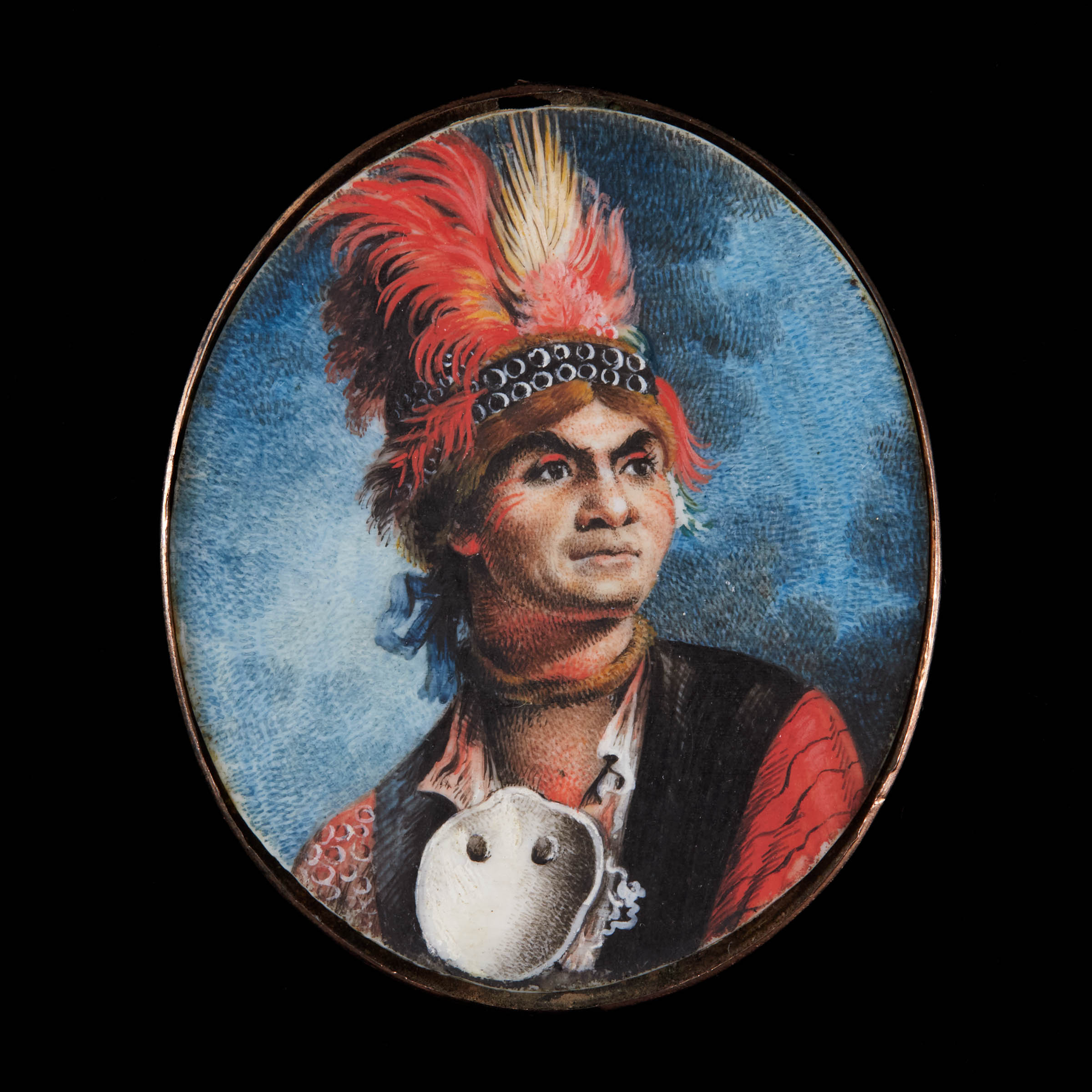
PORTRAIT OF KANYEN'KEHÀ:KA (MOHAWK) LEADER JOSEPH BRANT (THAYENDANEGEA), 1786
watercolour on ivory housed in gold plated locket
Believed to have been commissioned by Francis Rawdon, 1st Marquess of Hastings, and presented to Joseph Brant during his second visit to London in 1786
enamel on ivory housed in gold plated locket
2 x 1.625 x 0.625 in — 5.1 x 4.1 x 1.6 cm
Estimate $20,000-$30,000
Additional Images
Provenance:
Believed to have been presented by Francis Rawdon, 1st Marquess of Hastings to Joseph Brant (Thayendanegea) for his daughter Christina Brant Hill (Kainyaron), Ontario, 1786
Passed by descent to Catherine Johns, Brantford, ON
Thereafter possibly by descent to Catherine Kerr Osborne, Brantford, ON
Murray Turner, Hamilton, ON
By descent through the Turner family to the Estate of Patricia Gilbert-Turner, Norfolk, UK
Acquired from the above by the present Private Collection, Ontario
Exhibited:
Old Caneadea Council House, Genesee Valley, NY, USA, 1 October 1872
Joseph Brant Museum, Burlington, ON, 1992-1996
Note:
“She wore a gold locket containing an exquisite miniature likeness of her father painted in London. This, she said, was the most faithful likeness of Capt. Brant extant.”
William C. Bryant speaking of his visit with Catherine Johns (1790–1867), Matron of the Mohawk Turtle Clan and daughter of Joseph Brant
“I bow to no man for I am considered a prince among my own people. But I will gladly shake your hand.”
Attributed to Joseph Brant (Thayendanegea), Speaking to King George III, 1786
Joseph Brant, or Thayendanegea ("he sets or places together two bets") was a Kanyen'kehà:ka (Mohawk) war chief, interpreter, and statesman, and a hugely influential and trusted leader of the Haudenosaunee in the 18th century. Perhaps the best known First Nations figure of his era, he met and lobbied on behalf of Haudenosaunee with many of the most significant American and British people of the age, notably King George III of Great Britain, United States President George Washington, and British Major General Isaac Brock.
Brant's military exploits, which began at the young age of 15 were numerous and consequential. Among other actions, he took part in James Abercromby’s campaign to invade Canada by way of Lake George (Lac Saint-Sacrement) in 1758, accompanied Sir William Johnson, Superintendent of Northern Indians, in the 1759 expedition against Fort Niagara (near Youngstown, N.Y.), was with forces led by Jeffery Amherst that descended the St Lawrence to besiege Montreal, and in 1776 fought in the Battle of Brooklyn Heights, as well as countless skirmishes attached to ranger detachments led by Captain William Caldwell, and Captain Walter Butler.
As a statesman and interpreter, Brant visited with military and government officials in England in 1775-76 and again in 1785-86, most notably lobbying with King George III on behalf of the Haudenosaunee. Brant also met with George Washington in Philadelphia in 1792 to negotiate Kanyen'kehà:ka land claims in upstate New York. His war record, social and political savvy, and strong command of English, both the spoken and the written word, and fluency in multiple Six Nations dialects, made him ideally suited to matters of diplomacy. Until the time of Brant's death in 1807 he was active in territorial negotiations with the governments of Canada and the United States, a legacy for which Brant is remembered today.
Barbara Graymont, “Thayendanegea”, Dictionary of Canadian Biography, 1983, accessed 19 August, 2026, https://www.biographi.ca/en/bio/thayendanegea_5E.html
William C. Bryant, "Joseph Brant, Thayendanegea, and his Posterity" The Indian Miscellany (New York: J. Munsell, 1879), 145–157.
The "Lost" Miniature of Joseph Brant (Thayendanegea)
A set of three miniature paintings in goldplated lockets was presented to the Mohawk leader Joseph Brant (Thayendanegea) during his second visit to England in 1786 by Francis Lord Rawdon. Two of the miniatures show Brant and the third Lord Rawdon. Dedicatory inscriptions on the back of the lockets identify Brant’s wife Catherine and his daughter Christiana as the recipients of his likenesses and Brant as that of Lord Rawdon’s picture. All remained in possession of the Brant family at least until 1872, but one of them at an unknown point of time became the property of Murray Turner UE, was inherited by his descendants in England, and has now returned to Canada.
In 1785–1786, Joseph Brant (Thayendanegea) (1742–1807), the famous Mohawk ally of the British during the American Revolution, went to London to promote the compensation of the losses sustained during the war by the Mohawks and by himself. While waiting for a decision about these matters, he translated the Gospel according to St. Mark into the Mohawk language and enjoyed the attention he received from the nobility and the public at large.
Among his local intimates were British Army officers who had served in North America, including Hugh Percy, Earl of Northumberland (1742–1817), who was about to succeed his father as the second Duke of Northumberland, and Sir Francis Rawdon (1754–1824), who later became the second Earl of Moira, added his mother’s surname Hasting to his own, and subsequently served as Governor-General of India. Both of these men engaged the services of the American-born painter Gilbert Stuart (1755–1828) to have portraits painted of the distinguished visitor, who already had his likeness put on canvas ten years earlier by George Romney (1734– 1802) for George Greville, the second Earl of Warwick, during Brant’s first sojourn in London. Another painting of Brant, now considered lost, was made between January and April 1786 by John Francis Rigaud (1742–1810).
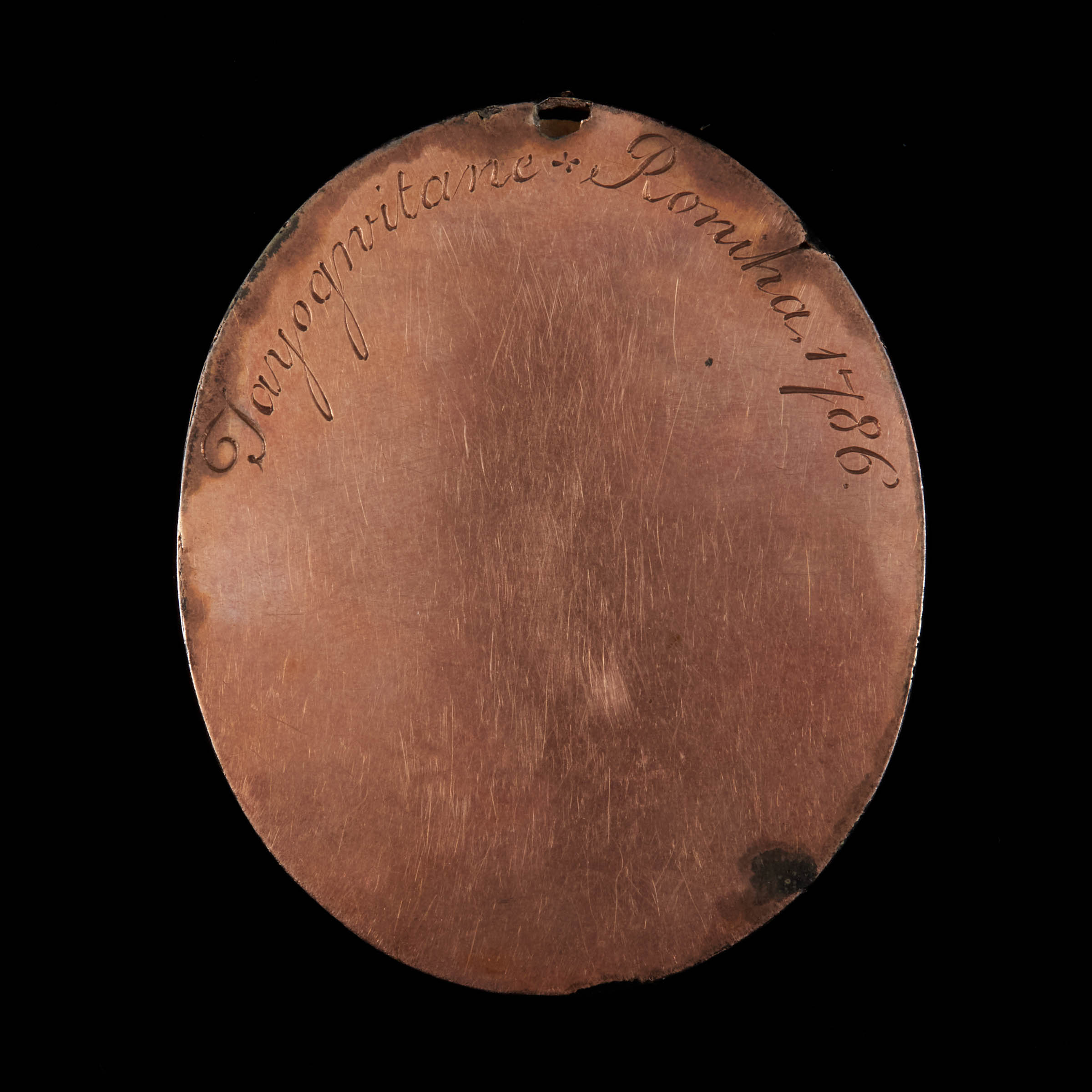
Brant’s relationship with Lord Rawdon must have been an especially close one, and when he returned to Canada, he brought along three miniature paintings as gifts from his noble friend, all mounted in gold-plated lockets with engraved dedicatory inscriptions on the back: a portrait of Lord Rawdon, attributed to the enamel painter Henry Bone (1755–1834) inscribed “From Lord Rawdon to his Friend Capt. Jos. Brant 1786”; a portrait of Joseph Brant also attributed to Bone, inscribed “Katerine Rone 1786”; and another portrait of Brant based upon the painting for Lord Rawdon attributed to Gilbert Stuart, inscribed “Tayogwitane Roniha 1786”. The inscriptions on the Brant miniatures are in Mohawk, presumably provided by Brant, and translated as “Katerine’s spouse” and “Tayogwitane’s father.”
Katerine is better known as Catherine (Ohtowa? kéhson) Croghan Brant (1759– 1837), Joseph Brant’s third wife, the daughter of George Croghan and Catherine (Tekarihoga) Croghan, and later clan mother of the Mohawk Turtle clan. Tayogwitane must refer to Christiana (Kainyaron) Brant Hill (1769–1832), Brant’s daughter from his first marriage with Margaret Neggen (Aoghyatonghersera), who later was identified as the owner of this miniature. While all three miniatures are of approximately the same size and mounted in comparable lockets, the one dedicated to Christiana differs in two important respects. It was clearly not painted by the same artist, and the enamel painting is not on copper, but on ivory.
A comparison of the miniature with the painting reveals some significant differences, notably the less Europeanized facial features (which are also closer to those on Stuart’s painting for the Earl of Northumberland), the shape of the left corner of the collar of Brant’s shirt, and the parallel lines of red face painting on the upper cheeks.
The same differences appear not only on a chalk drawing misattributed to Samuel Wale (1717?–1786) and identified as “depicting view of miniature of Joseph Brant—Mohawk chief, 1786?” and on a strikingly similar engraving by James Peachey (?–1797). Since Wale died on 5 February 1786, already suggested that “an attribution to another hand is conceivable.” In view of the similarity of the drawing and Peachey’s engraving, there is little doubt that Peachey was also the author of the drawing and most likely of the miniature as well.
This also helps to explain the re-indigenization of Brant’s features in the miniature, for which Peachey is the only reasonable candidate. After working for the surveyor general of the province of Quebec and of the Northern District of North America between 1772 and 1775, he returned to Canada in the early 1780s where received the patronage of Governor Sir Frederick Haldimand and produced a number of landscapes and ethnographic drawings before returning with Haldimand to England in November 1784. After Brant’s arrival in London, he produced the frontispiece for the Mohawk Primer and the Mohawk Prayer Book (Church of England 1787) with Brant’s translation of the St. Mark gospel. His association with Brant continued on his third trip to Canada (1789–1795) when he is reported to have made a portrait of Brant’s wife Catherine that unfortunately has not survived.
Even if Peachey was not the artist of the Joseph Brant miniature, he must have provided the drawing (adapted from the oil painting made for Lord Rawdon), which also served as the basis for his engraving. Peachey is not known to have worked in enamel, but since Nicholas Panes noted that it could not be ruled out that the Joseph Brant miniature was “an apprentice piece,” Peachey would also qualify as the artist of the miniature.
Provenance
After the death of Christiana in 1832, whose marriage with Henry Aaron Hill apparently remained without issue, the miniature based upon the Stuart painting passed into the property of her half-sister Catherine Johns (1790–1867) who had succeeded her mother as the matron of the Mohawk Turtle clan. It was in her possession when the local historian William Bryant saw it and later published a drawing he had made of it. Catherine felt it “was the most faithful likeness of Capt. Brant extant”.
Who owned the miniature after Catherine’s death is unknown, but in 1872 it was lent by the Brant family together with the two other miniatures for a presentation during a commemorative meeting at the Old Caneadea Council House in the Genesee Valley. It may have been brought along by William John Simcoe Kerr and his sister Catherine Kerr Osborne, the children of the late Elizabeth Brant Kerr (1796–1845), Joseph Brant’s youngest daughter, who in 1838 was reported to have owned the Lord Rawdon miniature. After the death of W. J. Simcoe Kerr in 1875 and of his sister in 1876, the trail of the miniature once dedicated to Christiana Brant turns cold.
The missing miniature made a temporary comeback in 1992, when it was lent to the Joseph Brant Museum by Simon Turner of Sussex, England, but was returned to the Turner family in 1996. According to a family tradition, the first Turner known to have owned the miniature of Joseph Brant was Murray Turner, UE, associated with the Belleville area and Ashbury College.
There were in fact two Murray Turners, grandfather and grandson, who were conflated in the tradition. The grandfather (1856–1890) was an alderman of Belleville, but would not qualify for UE because his parents had only recently immigrated from Scotland. The grandson (1911–1991), Simon’s father, must have claimed the hereditary honorific title United Empire through the line of his grandmother, the first Murray’s second wife, Faustine Jane Foster (1856–1925), whose grandfather Shubael Foster had emigrated from Martha’s Vinyard to Upper Canada after the American Revolution and settled in the Loyalist community at Meyer’s Creek (now Belleville).
The younger Murray was the only son of Faustine Foster’s daughter Flavelle Turner (1888–1976) and the Ottawa banker George Louis Taillon (1883–?). After the disappearance of Taillon from the record soon after Murray’s birth and his baptism as George Murray Taillon, the son took the name of his grandfather Murray Turner (while his mother kept the name Flavelle Taillon until her death). Murray attended Ashbury College and later McGill and Queen’s University, while his now single mother, despite the fact that she must have inherited George Taillon’s fortune, worked at the Ottawa General Hospital, where she rose to the rank of chief dietician. She lived a busy social life, spending her and Murray’s holidays in the British West Indies and on Cape Cod, close to where her grandfather had come from. Mother and son also regularly returned for visits to Belleville.
Murray became a career officer in the Canadian Army, and after marrying in 1941 the daughter of the British Lieut. General Desmond Francis Anderson (1885–1967), ultimately moved to Sussex, England where he died in 1991.
In the absence of documentary evidence for the transfer of the “lost” miniature from the Brant to the Turner family, the provenance of the two miniatures at the Joseph Brant Museum provides some clues. They were acquired in 1969 from Mary Brew of Winnipeg, a great-great-granddaughter of Joseph Brant. It is notable that (with the exception of the Rawdon miniature which passed from Joseph Brant to his daughter Elizabeth) all the miniatures were inherited in a female line.
After the death of Catherine Elizabeth Kerr Osborne in 1876, the two miniatures and probably the “lost” miniature as well were inherited by her daughter Jane Earl Miller, who was then only thirteen years old. Together with her father John Osborne and her sister Jessie Murray Osborne she moved from Hamilton, Ontario to Manitoba, where in 1886 she married Edwin Donaldson Kerby. Since it is unlikely that the transfer had taken place after the miniatures had gone to Manitoba, there is a window of only ten years for it to have occurred. It may be possible that the “lost” miniature was inherited by her sister Jessie, but since Jessie also moved to Manitoba, the same consideration applies. This excludes the possibility that George Murray Turner (Taillon) had been the first Turner to own it.
However, a look at the parallel genealogies of the Brant and Turner families may provide an answer. Like John Osborne, Elizabeth Osborne, the wife of John Turner and Murray Turner’s father, had been born in Scotland and, while there is no proof for their kinship, both came to Hamilton in the 1840s. Since John Turner had already died in 1859, Elizabeth Osborne Turner could have been the missing link.
A little less likely link is the Loyalist connection of both Brant and Murray Taylor’s wife Faustine Jane Foster. Although it has been argued that Brant was not truly a Loyalist, but an Iroquois statesman exploiting his close ties to the British for the benefit of his people, Brant also appears to have been active in preserving the Loyalist heritage. This tradition was continued by his descendants, including Mary Brew who in the 1960s gave a paper on her ancestor to the UE Loyalist Branch in Winnipeg.
In any case, this transfer (other than that of communally owned items, such as wampum belts) was completely within the bounds of traditional usage, since the miniatures had always been the private property of the Brant family.
The research and essay for this lot was contributed by Christian Feest and is presented above in an abridged format. A digital copy of the complete essay including extensive illustrations is available to clients upon request.
Christian Feest is widely acknowledged for his pioneering research and publications on the early European-Native American colonial contact period, and on the history of museum collections. Former curator of the North and Central American collections at the Museum für Völkerkunde (Museum of Ethnology) in Vienna, and later director, he was also professor at the Institute of Historical Ethnology at the Johann Wolfgang Goethe University of Frankfurt am Main, served as a post-doctoral fellow at the Smithsonian Institution in Washington DC, as a Ford Foundation Fellow at the Newberry Library in Chicago, and was Mellon Global Curator at the Indianapolis Museum of Art. Christian Feest is currently an independent scholar and exhibition curator.