


A family’s Passion for Inuit art
This two-generation legacy of building a collection reflects some of the greatest achievements in Inuit art, starting from the first days of the Inuit art market.
Waddington’s has been privileged to work with many of the preeminent collectors of Inuit art, often in full circle relationships, providing market guidance and assistance both in the acquisition and sale of artworks. Works included in this extraordinary West Coast Private Collection have passed between two generations of collectors, in some instances were bought through Waddington’s, and have now been passed on to us to find their way to new collectors.
It’s been an honour to work with the consignors over many years, and we thank them for sharing some insight into their collecting journey.
W – Your collection spans two-generations started in the early 1960s. How or why did the first generation start collecting?
The first generation had long been interested in the art forms of Indigenous people who had often lived in very harsh environments, but in harmony with local wildlife and with a compulsion to create art in various forms. When Canadian Inuit art began to reach their attention initially via the early to mid-1960s Cape Dorset print releases, they were immediately taken by the parallels and the contrasts with other Indigenous art they has already known. Their daughter caught the bug from them and it proved to be contagious!
W – What is it about Inuit art, a very Canadian artform, that attracted you?
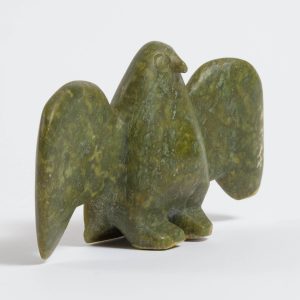
OWL, CA. 1960
3.75 x 6.75 x 1.75 in — 9.5 x 17.1 x 4.4 cm
While Inuit art is a very Canadian art form today, we love it because it also seems very pre-Canadian and even ancient! It has an immediacy and directness, and often a sense of having been stripped down to its essence; both elemental and sophisticated at the same time. The fluidity of line, sensuous curves, and use of negative space feels abstract, very modern, and quite ancient all at once.
Much of the sculpture fits nicely in the hand and thus is easy to appreciate from all angles. We have tended to collect mostly animal and spirit forms in both prints and sculpture, as did the previous generation.
W – Important collections aren’t built by accident, but are assembled over years of passion and perseverance, with attention to detail. What kind of relationships have been helpful to you in building this collection?
Over the years, we’ve had a chance to travel and visit various museums and galleries, attend lectures, and meet experts, study community print and auction catalogues, and of course bid at auctions in person, by phone and online.
W – You have been to various communities in the Arctic, and on multiple visits to Nunavut. Who did you meet?
Multiple trips to Nunavut over the years included visits to Arviat, Rankin, Cape Dorset, Igloolik, Baker Lake, and Bathurst Inlet, and the pleasure of meeting several wonderful artists in their homes, including Kenojuak, Osuitok, Kananginak, and Nutaraluk. On some visits we were even fortunate enough to buy some pieces while there.
W – With an Inuit art collection as significant as yours, was it difficult to display? Your meticulous storage allowed you to rotate pieces, was this always part of your strategy?
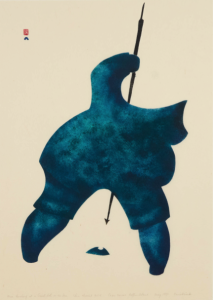
MAN HUNTING AT A SEAL HOLE IN THE ICE, 1959
At first when we bought prints, we could envision where they would be displayed. We soon ran out of walls but then discovered archival quality folders with mylar covers and archival storage boxes to keep them in. When those filled the available space under our bed, we commissioned production of a large custom ten drawer print storage cabinet.
When our sculpture collection exceeded the capacity of available display spaces and custom sculpture stands, we had a carpenter design and build drawers and movable shelving for a climate-controlled basement storage room.
W – Artworks in your collection are meticulously identified and labeled. When not on display, they were stored with great care and as a result have been preserved in exceptional condition. Do you believe collectors have a responsibility to be good stewards of the art?
We never thought of our collection as really ours; we always knew we were holding it in Trust for the next generation of enthusiasts and have now decided it was time to ask Waddington’s to help our collection find new homes with folks who will treasure them as we have.
W – Are there other types of art in your collection? One of our clients mixes Inuit, European, and Ethnographic works; doesn’t display them by genre, but what looks complementary together.
We also have pottery and baskets from the American southwest, antique Japanese screens, scrolls, and prints, early to mid-19th century oriental tribal rugs, and contemporary art glass other craft work, all of which have lived happily and in harmony with our Inuit art.
W – Who are your favourite top five artists – Inuit, other?
You asked for our five favorite Inuit artists – a truly impossible question and very unfair! But we can safely say that among our dozens of favorite artists are Kenojuak, Osuitok, Niviaksiak, Kananganak and Etungat. Non-Inuit favorite artists include Rodin, Maria Martinez, Nampeyo, Margret Tafoya, and Joseph Lonewolf.
About the Auction
This collection is featured in our 2026 major fall auction of Inuit Art alongside selections from a significant Massachusetts estate. Highlights include major works by Abraham Etungat, Osuitok Ipeelee, Henry Evaluardjuk, Pudlo Pudlat, Tudlik, Niviaxie, Kenojuak Ashevak, Barnabus Arnasungaaq, Lukta Qiatsuk, Ningiukulu Teevee, Pitaloosie Saila, Kananginak Pootoogook, and John Kavik. Also included is a small collection of ancient Arctic ivories.
On view at our Toronto gallery:
Saturday, November 14 from 12 pm to 4 pm
Sunday, November 15 from 12 pm to 4 pm
Monday, November 16 from 10 am to 5 pm
Tuesday, November 17 from 10 am to 7 pm
Wednesday, November 18 from 10 am to 5 pm
Or by appointment.
Contact us for more information at [email protected]
Related News
April 14, 2026

April 12, 2026

December 18, 2024

December 16, 2024

December 16, 2024

December 20, 2023

April 27, 2023
June 28, 2022
Meet the Specialists
Palmer Jarvis
Senior Specialist

Elizabeth Gagnon
Consignment Specialist